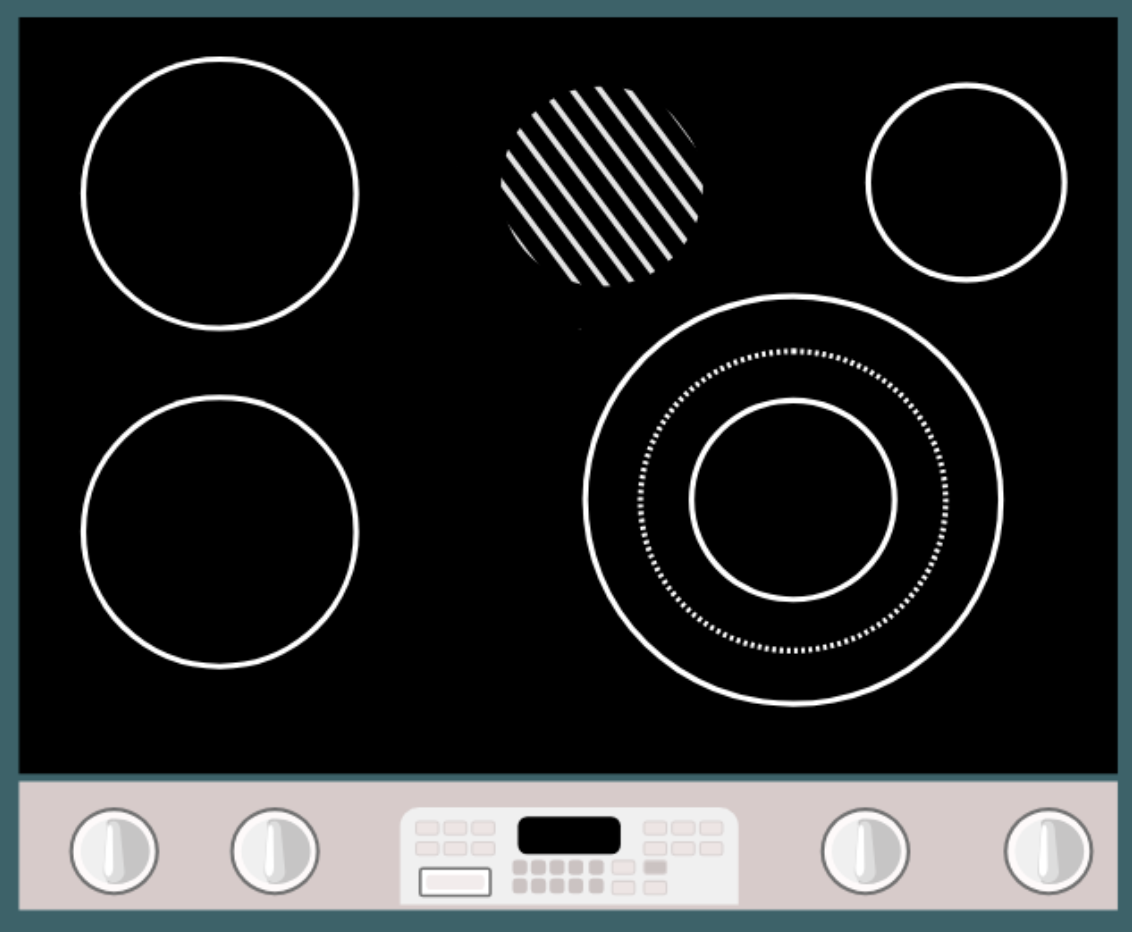
The picture shows a cooking stove, but it looks more like an intelligence test. In his classic book on design, Donald Norman uses this as a non-example of the first rule of design, to focus on what the end users need.
He could have chosen England’s National Curriculum for Science.
Its designers focussed on the 10% minority who go on to study STEM, and ignored the needs of the 90% majority who don’t continue science beyond GCSE (based on exam entry data),
These students are entitled to an education that equips for dealing with science-based issues and misinformation in their everyday lives. But they often take away little more than an exam certificate, because the curriculum has ended up rather like my wardrobe: full of a lot of old stuff, most of which no one will ever use, but which has somehow resisted being thrown out.
Scientific organisations, like the Royal Society recognise this. So do the students: approximately 60% of 11-18 year olds do not believe science is relevant to their lives (Wellcome 2019). But don’t count on politicians putting things right.
Life-worthy
In this article I will sketch out the steps of a solution we can take without government reform. I know they’re possible because we basically followed the same steps to build Mastery Science’s KS3 framework and ‘Proper Science’ course.
Step 1: Apply the life-worthy test
In his book ‘Futurewise’ (2015), David Perkins of Harvard University suggests the first step. It’s a ‘lifeworthy test’. For every piece of content you ask: “How is X going to matter to the lives learners are most likely to live?”
To answer it, we need to decide what makes content lifeworthy. From all the different country’s curricula I’ve seen, I’ve extracted three criteria that cover most of the bases:
Criteria 1: Intellectual power
As the old saying goes, an ounce of understanding is worth a pound of knowledge. Education has now caught up, and almost everyone agrees that our curriculum wardrobe needs to prioritise big understandings like interdependence, with less space for niche ideas like mitosis, which can be learned later when needed.
Criteria 2: Personal relevance
Lifeworthy means filling our curriculum wardrobe with the stuff students are going to use everyday life, either in a personal context like home energy, or a professional one, like doing an environment risk analysis.
Criteria 3: Societal impact
Beyond personal usefulness, life-worthiness also means students being able to participate as citizens in the local, national or global challenges we face. This means more time translating knowledge about climate change and sustainability into actionable skills like examining policy options and trade-offs.
Now we have a clear definition of life-worthiness, we apply each criteria to the existing content. This will highlight what’s most intellectually powerful, what’s most personally relevant, and what’s most socially impactful. This prioritisation helps us decide how much wardrobe space each topic should get.
What’s critical that this process is carried out in an unbiased way. That means not giving the job to learned societies or university scientists who have too much interest in preserving their subjects.
Step 2: Integrate skills with content
Life-worthiness is not just knowing stuff it’s putting it to use. GCSE works against this by devoting 100 pages specifying content in detail, a couple making vague reference to the science practices (aka working scientifically) needed to make sense of situations, and one small boxes to the higher order thinking (aka Assessment Objective AO3) students need to do something useful. Little surprise then that content knowledge becomes teachers’ main focus.
I know two ways to signal life-worthiness in the curriculum statements. One is the approach taken by the US science curriculum (NGSS). Here standards are written as ‘learning performances’ which pair one conceptual understandings with one particular science practice. This way the skills and application are baked in from the start.
Mastery Science took a slightly different approach in the KS3 Science Syllabus (which we designed for AQA) and our Blueprint curriculum framework. We used a progression of levels of objectives from Acquire, to Apply, to Analyse, that specify how each concept needs to be used in real-life situations.
Step 3: Balance life-worthiness with exams
At this point you might be questioning the realism of this design. After all, you’ve got to cover what the GCSE specification prescribes. There are ways to meet this constraint without sacrificing life-worthiness. One way is to focus on life-worthiness for the first four years (7-10) and then switch over to exam-worthiness for the GCSE year, and fill in all the gaps.
A topic like climate could be explored in year 9, and the mechanism of the greenhouse effect left to later. This approach has some backing from cognitive science – it’s fairly easy to add lots of facts when students can connect them to an existing understanding.
If the Government followed these steps, we would end up with a science curriculum framework that properly serves the 90% majority of students. But why wait for policy changes that may never happen?
If you’re interested in implementing these principles in your own teaching context, I’l try to help by expanding on the strategies you need in upcoming articles. For now, I’m going to see if the principles can help me sort out my wardrobe.
I’d love to know what you think …
 Practising Science: Tony Sherborne's blog
Leave a comment